
 Visit Today :
 This Month :
 Total Visit :
 Hits Today :
 Who's Online :
The following books are available for sale / Die volgende boeke is beskikbaar.
From Science, Philosophy and Spirituality to your Own Religion – (Albie Gibson – Bloemfontein 2003)
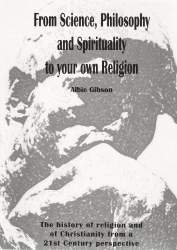
Executive Summery
The importance of the influence of some ancient religious and philosophical traditions on the theories of salvation of early Christianity is often understated. When reading the Bible in an independent way, i.e., not through the lenses of any official church dogma, one is amazed by the many voices that come through to us. Add to this variety the literary finds from Nag Hammadi, as well as the Dead Sea Scrolls, then the question now confronting many spiritual pilgrims is how it came about that these obviously diverse theologies, represented in the so called Old and New Testaments, were moulded into only one “orthodox” result. In what way and to what degree were the many Christian groups different and distinctive form one another, as well as from Jewish groups? Furthermore, what was the influence of other religions, Judaism, the Mysteries, Gnostics and the Philosophers on the development, variety of groups and ultimately, on the consolidation of the “orthodox” religion?
Every individual will, to a certain extent, have to make sense of his life, the world and his own inborn spiritual instincts to experience his existence as meaningful. To give meaning to life is therefore an ageless and universal human quest. Life develops from a struggle for survival, is then followed by our efforts to understand reality as well as our place and tasks in the cosmos, culminating in personal and perhaps shared, meaningful philosophical answers. Alternatively, many want life to culminate in a perceived condition called “salvation”, which can be described as “the peace that passeth understanding” (Phil.4:7) and results in a lack of fear of death. Salvation, as personal peace and a feeling of contentment, can therefore be described as the ultimate goal in the process of human striving. However, many struggle to get beyond base one, for a variety of complex and mysterious reasons, which in itself represents one of the difficult questions about the Mysteries of Life. This early capitulation of the personal quest to meaning is also one of the main reasons for resorting to other people or groups for a shorter, “easier” route to meaning and salvation. This proverbial easy way out through adopting uncritically a “faith only” solution, a “canned” total package approach to meaning and salvation, seems to ignore very important human modalities in our development towards fully integrated, mature human beings. Personal experiences and developmental psychology, suggest strongly that in the process of becoming fully mature, one will have to master the “this-worldly” questions, to a fair degree of satisfaction and in a predominantly rational modality of our humanness, before the more advanced quest for spiritual maturity will be experienced as meaningful.
From the perspective of virtually infinite possible human differences, coupled to a bewildering number of likely family and social influences in a global and virtual environment, personal and philosophical-religious variety should be the expected norm and not generalized universal orthodoxy. But is this scenario valid only in our day and age? Did circumstances and humanity change that much from the time of Jesus or were there other factors in operation that made us believe that an extraordinarily unified orthodoxy prevailed since his time?
Personal spiritual discontent, coupled to the sometimes, irrational dogmatic answers of the mainstream Christian churches do not seem to satisfy the modern spiritual seeker any more. However, did dogmatic, theological answers ever satisfy serious spiritual seekers? Furthermore, you do not have to be a theologian to notice that many different theologies are coming through to us from our current Bible, a fact that seems to be deliberately ignored by present Christian theology in an effort to present a consensus theology as claim to uniqueness. This book is essentially the provisional result of my own search to understand and to make sense of spirituality and religion in a broader inclusive context. In this process, I tried to get a grip on as many aspects that define and constitute our human spiritual experiences as possible, while knowing that this is, from a human perspective, virtually impossible owing to complexity and interrelatedness. It can however, lead to further confusion on a temporary basis. Nevertheless, something within compels us or seems to encourage us to try to make sense of our spiritual life. This is therefore, a personal quest leading to a historic-critical study of the roots of human spirituality and religion in an effort to understand my outdated, (personal opinion) Christian religion in a technologically driven, multicultural and in global economical world. What I found was both liberating and encouraging if one accepts the fact that there can be but one God and that He/She/It cares for its whole creation. That variety in the socio-cultural, exoteric elements of religions is normal and to be expected and that possibly, the majority of early Christians shared this view, while on the other hand, the inner, authentic part or esoteric element of religions is basically the same in all great religions. Mature spirituality is a “One to one” affair and does not need a Church for its spiritual evolvement. Some churches could even be a spiritual hindrance if they do not help their members to grow from the social-religious stage to the personal, mystical stage.
Albie Gibson
(cell. 0825 780 752 )
The Way of Solomon
“When standing before God you rush to speak, your heart bursting with needs and urgency. You crowd the air with words of praise and pleading. You leave no room for Silence and none for hearing. It is not God you worship, but your own voice and opinion… Better to stand in Silence. Do not rush your words, but seek to quiet them. With a quiet mind, a heart still and silent, you will see the infinity of God and the finity of self. Humility will embrace you, and you will fade into That Which Is All That Is. Your words will be few; the Silence, great. There is room then for listening.”
Eccl. 5:1 (Translation: Rami Shapiro, 2000)
“What shall you do? Work yourself to distraction? Distract yourself from work? Neither extreme is desirable. Better the middle way: eat and enjoy your food in the company of friends; work and enjoy the capacity of body and mind. In this world of seeming separation and divided minds, there is no escape from impermanence. Do not build a fortress against loss or lay siege to eternity. Rather open your eyes to the wonder of the fleeting and make of each moment an opportunity to do what needs doing. Your days are few and you cannot know which will be your last. Appreciate the moment. Sharpen your mind. Live with attention. Live without expectation. And let sorrow and joy take care of themselves.”
Eccl. 5:17(Translation: Rami Shapiro, 2000)
.
- A free copy of this book is available in pdf format.
- A few printed copies are still available at R35.00 plus postage. Please contact me to arrange postage and payment. (You can use the Contact page for this purpose)
 Firstly, we all need Economic, Technological and Interpersonal Skills and productive Attitudes to survive in the 21st Century world. As this is a very broad field this website will only try to address some economic skills for personal survival and enrichment.
 Secondly, we need some Philosophical background in our effort to Question and Analyse our Cultural and Ideological preferences or biases and to understand the differences between our Persona or ego-self and the mystery of the Real Self. These topics represent the tools to Awakening and Self-realisation.
 Thirdly, in the mature phase of life, people realise that money and material things alone do not bring personal satisfaction, peace or meaning to their lives. The quest for Wisdom and Insight invariably lead us to the realisation that we need to know where we come from and a new quest for Personal Spiritual Development.
